产品目录
客服热线(售前售后)
13805064553
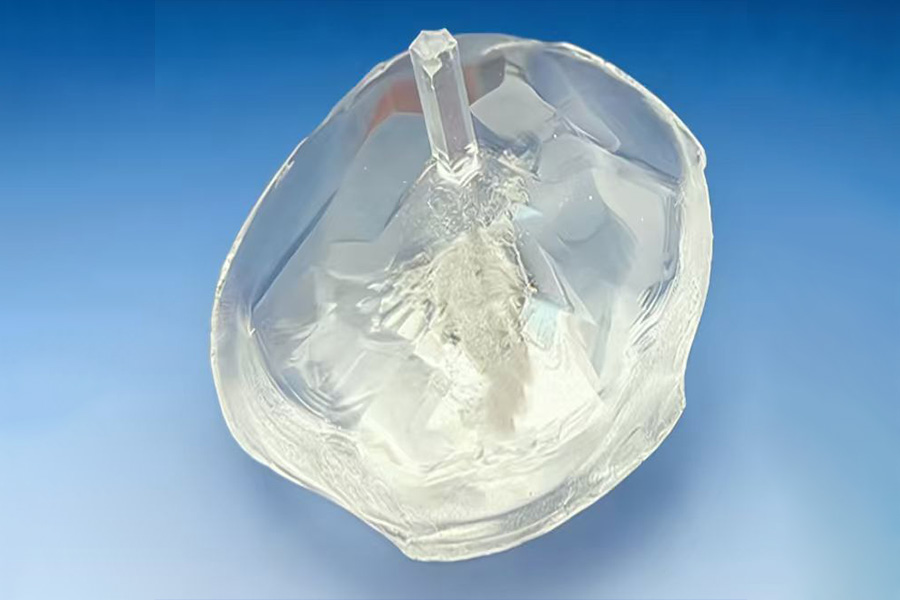
Our company has achieved a key breakthrough in BBO crystal growth technology, breaking the long‑standing domestic reliance on the traditional flux method. We have successfully developed a Czochralski (CZ) method for growing BBO crystals, overcoming the industry challenge of significant two‑photon absorption inherent in conventional processes.
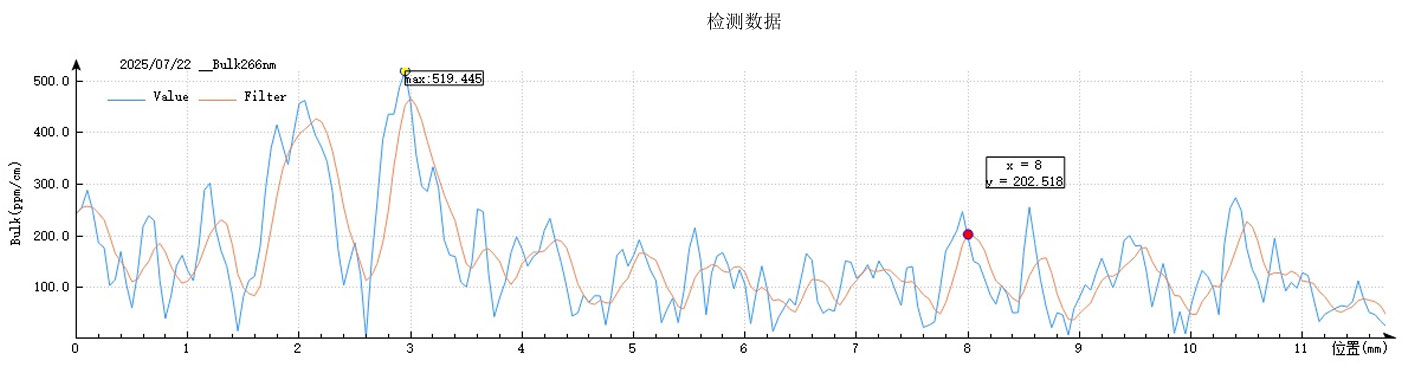
Test results show that BBO crystals prepared by the CZ method have an absorption coefficient approximately 20 times lower than those produced by the traditional flux method. This greatly reduces optical energy loss in the deep‑UV spectral range, making the crystals especially well suited for 266 nm deep‑UV laser applications. They provide core material support for high‑end fields such as semiconductor lithography inspection and precision UV micro‑processing.
|
Physical Property
|
Value
|
Remarks
|
|
Crystal Structure
|
Trigonal system, negative uniaxial crystal
|
|
|
Unit Cell Parameters
|
a = b = 12.532 Å, c = 12.717 Å, Z = 6
|
At room temperature
|
|
Melting Point
|
1095 ± 5 °C
|
/
|
|
Mohs Hardness
|
4.5
|
/
|
|
Density
|
3.85 g/cm³
|
/
|
|
Thermal Conductivity
|
⊥c: 1.2 W/m·K; ∥c: 1.6 W/m·K
|
At room temperature
|
|
Thermal Expansion Coefficient
|
α₁₁ = 4 × 10⁻⁶ /K, α₃₃ = 36 × 10⁻⁶ /K
|
25 ~ 900 °C
|
|
Transmission Range
|
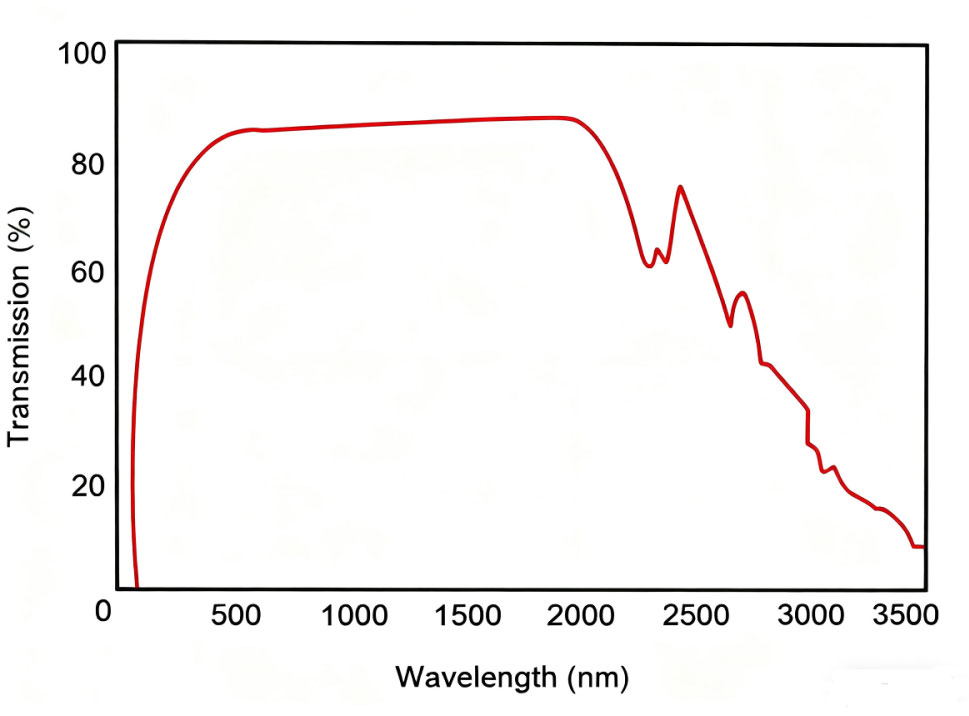
189 ~ 3500 nm
|
/
|
|
SHG Phase Matching Range
|
409.6 ~ 3500 nm (Type I); 525 ~ 3500 nm (Type II)
|
At room temperature
|
|
Thermo‑optic Coefficient
|
dnₒ/dT = –16.6 × 10⁻⁶ /°C; dnₑ/dT = –9.3 × 10⁻⁶ /°C
|
At room temperature
|
|
Absorption Coefficient
|
α(1064 nm) < 0.03 %/cm;
α(532 nm) < 0.05 %/cm; α(266 nm) < 0.1 %/cm |
/
|
|
Beam Divergence (Acceptance Angle)
|
0.8 mrad·cm (Type I, 1064 nm SHG);
1.27 mrad·cm (Type II, 1064 nm SHG) |
/
|
|
Temperature Bandwidth
|
~55 °C·cm (1064 nm SHG)
|
/
|
|
Spectral Acceptance Width
|
1.1 nm·cm (1064 nm SHG)
|
/
|
|
Walk‑off Angle
|
2.7° (Type I, 1064 nm SHG);
3.2° (Type II, 1064 nm SHG) |
/
|
|
Nonlinear Optical Coefficients
|
d₁₁ = 5.8 × d₃₆(KDP);
d₃₁ = 0.05 × d₁₁; d₂₂ < 0.05 × d₁₁ |
At room temperature
|
|
Nonzero Nonlinear Optical Coefficients
|
d₁₁, d₃₁, d₂₂ (nonzero, with d₁₁ the largest)
|
Determined by crystal symmetry
|
|
Electro‑optic Coefficient
|
γ₂₂ = 2.7 pm/V
|
At room temperature
|
|
Half‑wave Voltage
|
48 kV (1064 nm, 3 × 3 × 20 mm)
|
/
|
|
Resistivity
|
> 10¹¹ Ω·cm
|
At room temperature
|
|
Relative Dielectric Constant
|
εᵀ₁₁/ε₀ = 6.7; εᵀ₃₃/ε₀ = 8.1; Tan θ < 0.001
|
|
|
Specification Item
|
Parameter Details
|
|
Dimensional Tolerance
|
(W ± 0.1 mm) × (H ± 0.1 mm) × (L + 0.5/–0.1 mm); custom sizes available upon request
|
|
Effective Clear Aperture
|
≥ 95% of central area
|
|
Surface Finish
|
10/5 (per MIL‑PRF‑13830B standard)
|
|
Flatness
|
≤ λ/8 @ 633 nm
|
|
Transmitted Wavefront Distortion
|
≤ λ/8 @ 633 nm
|
|
Parallelism
|
20″
|
|
Perpendicularity
|
15′
|
|
Angular Tolerance
|
≤ 0.25°
|
|
Chamfer
|
≤ 0.2 mm × 45°
|
|
Edge Chipping
|
≤ 0.1 mm
|
|
Damage Threshold
|
> 1.5 GW/cm² @ 1064 nm, 10 ns, 10 Hz (polished substrate);
> 0.3 GW/cm² @ 532 nm, 10 ns, 10 Hz (with AR coating) |
|
Quality Guarantee Period
|
One year (under normal usage conditions)
|
 |
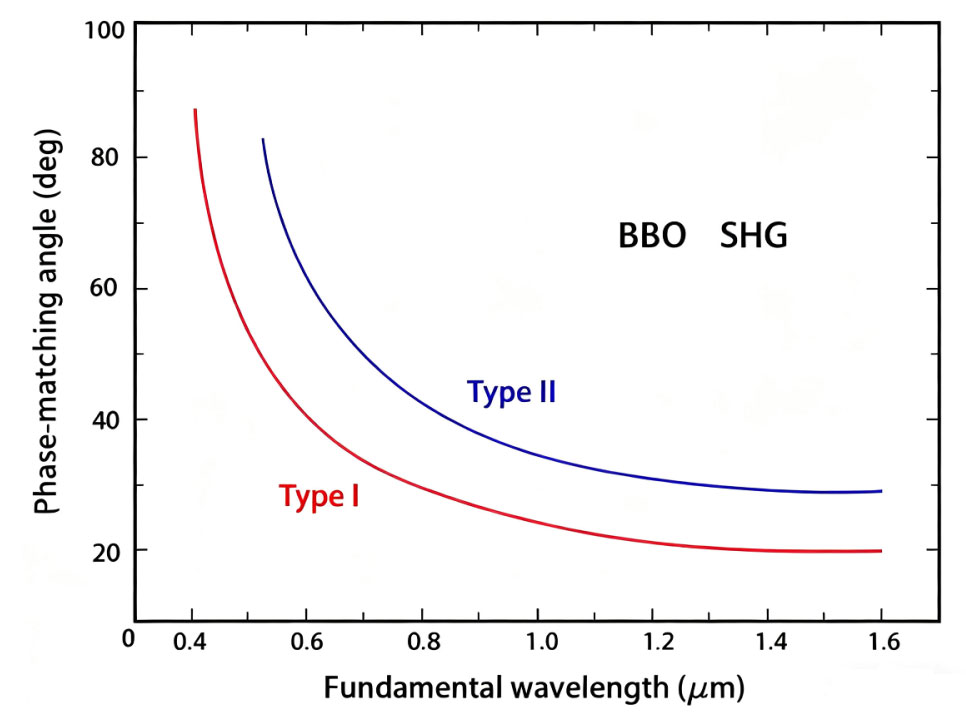 |
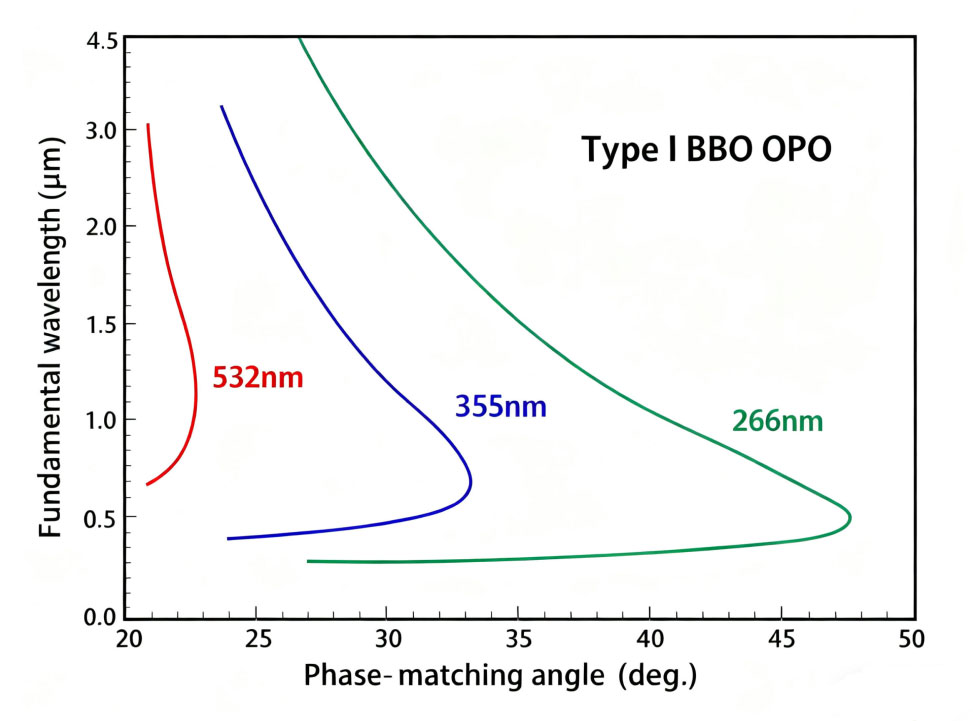
| BBO crystal transmission curve | The tuning curves of type I and type II SHG. |
 |
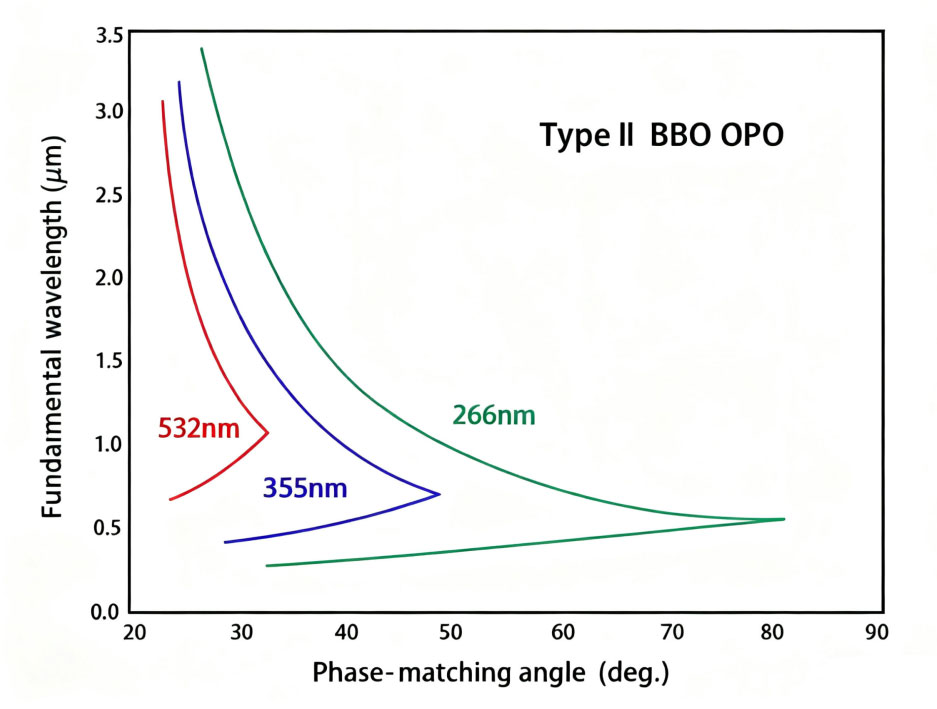 |
| Type I BBO OPO tuning curve (@532/355/266 nm) | Type II BBO OPO tuning curve (@532/355/266 nm) |