EN
客服热线(售前售后)
13805064553

BBO

BBO, short for β‑barium borate crystal (β‑Barium Borate Crystal), is a highly important nonlinear optical crystal widely used in laser technology. It is also one of the most mature nonlinear optical crystals for ultraviolet applications available today.

Technical Specifications
Custom specifications available upon request

Product Features​

Our company has achieved a key breakthrough in BBO crystal growth technology, breaking the long‑standing domestic reliance on the traditional flux method. We have successfully developed a Czochralski (CZ) method for growing BBO crystals, overcoming the industry challenge of significant two‑photon absorption inherent in conventional processes.

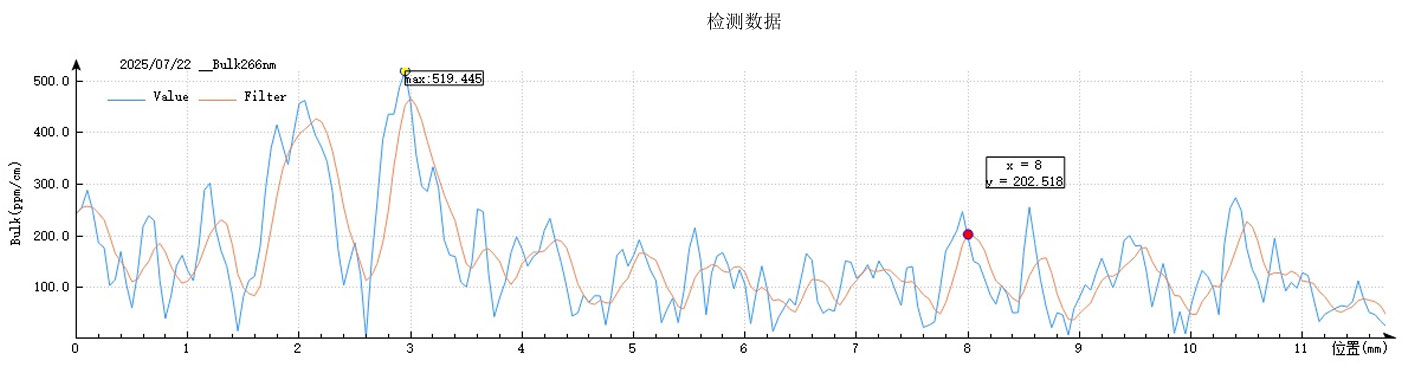
Test results show that BBO crystals prepared by the CZ method have an absorption coefficient approximately 20 times lower​ than those produced by the traditional flux method. This greatly reduces optical energy loss in the deep‑UV spectral range, making the crystals especially well suited for 266 nm deep‑UV laser applications. They provide core material support for high‑end fields such as semiconductor lithography inspection and precision UV micro‑processing.

Basic Properties

Physical Property
Value
Remarks
Crystal Structure​
Trigonal system, negative uniaxial crystal
 
Unit Cell Parameters​
a = b = 12.532 Å, c = 12.717 Å, Z = 6
At room temperature
Melting Point​
1095 ± 5 °C
/
Mohs Hardness​
4.5
/
Density​
3.85 g/cm³
/
Thermal Conductivity​
⊥c: 1.2 W/m·K; ∥c: 1.6 W/m·K
At room temperature
Thermal Expansion Coefficient​
α₁₁ = 4 × 10⁻⁶ /K, α₃₃ = 36 × 10⁻⁶ /K
25 ~ 900 °C
Transmission Range​
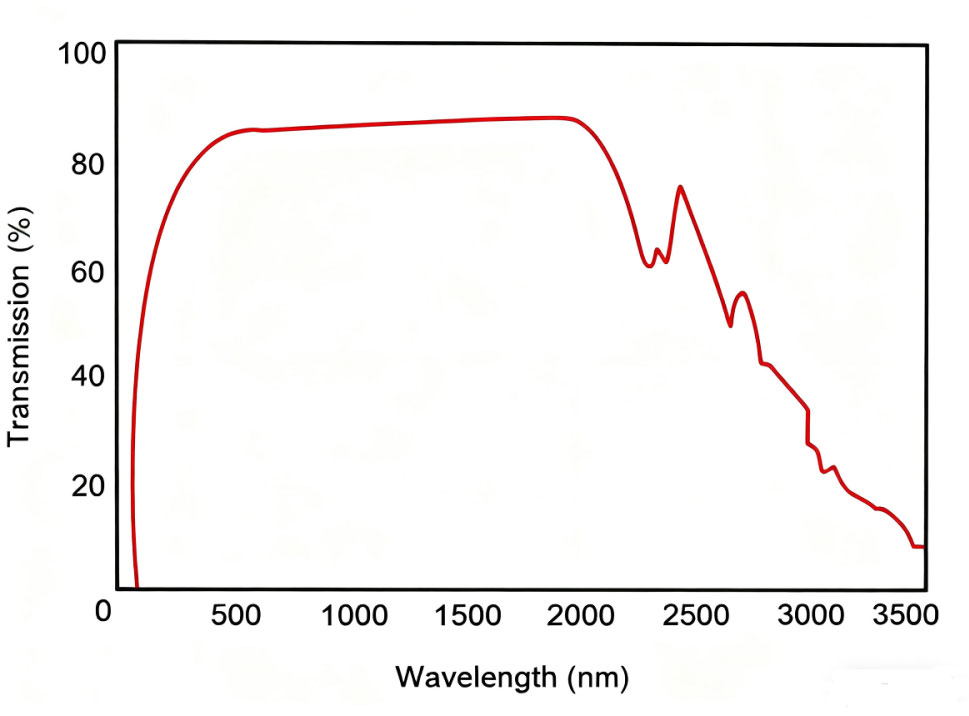
189 ~ 3500 nm
/
SHG Phase Matching Range​
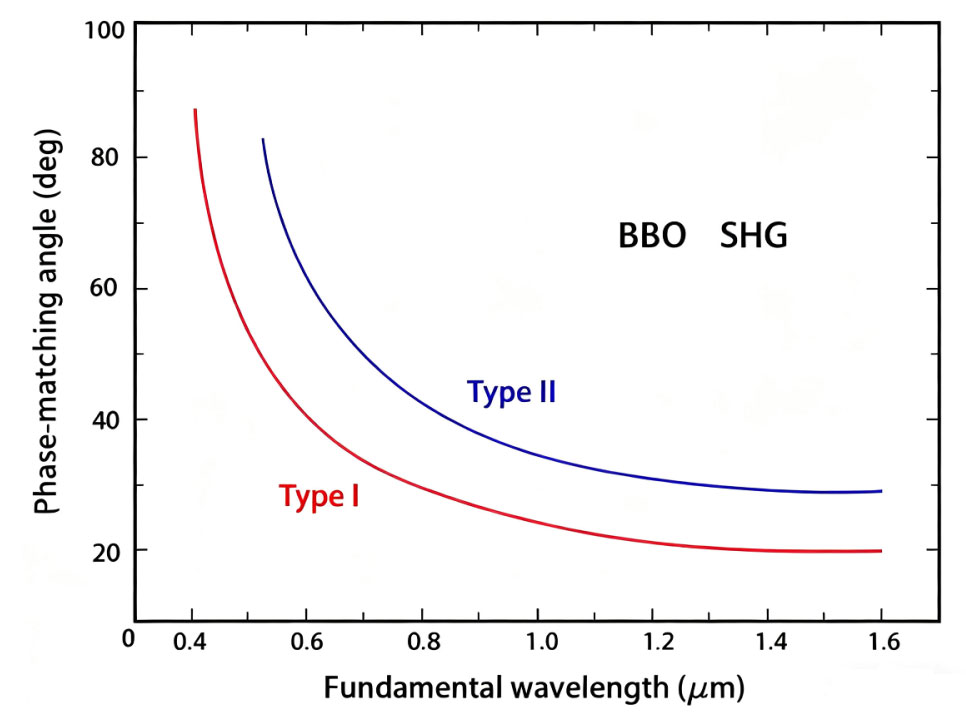
409.6 ~ 3500 nm (Type I); 525 ~ 3500 nm (Type II)
At room temperature
Thermo‑optic Coefficient​
dnₒ/dT = –16.6 × 10⁻⁶ /°C; dnₑ/dT = –9.3 × 10⁻⁶ /°C
At room temperature
Absorption Coefficient​
α(1064 nm) < 0.03 %/cm;
α(532 nm) < 0.05 %/cm;
α(266 nm) < 0.1 %/cm
/
Beam Divergence (Acceptance Angle)​
0.8 mrad·cm (Type I, 1064 nm SHG);
1.27 mrad·cm (Type II, 1064 nm SHG)
/
Temperature Bandwidth​
~55 °C·cm (1064 nm SHG)
/
Spectral Acceptance Width​
1.1 nm·cm (1064 nm SHG)
/
Walk‑off Angle​
2.7° (Type I, 1064 nm SHG);
3.2° (Type II, 1064 nm SHG)
/
Nonlinear Optical Coefficients​
d₁₁ = 5.8 × d₃₆(KDP);
d₃₁ = 0.05 × d₁₁;
d₂₂ < 0.05 × d₁₁
At room temperature
Nonzero Nonlinear Optical Coefficients​
d₁₁, d₃₁, d₂₂ (nonzero, with d₁₁ the largest)
Determined by crystal symmetry
Electro‑optic Coefficient​
γ₂₂ = 2.7 pm/V
At room temperature
Half‑wave Voltage​
48 kV (1064 nm, 3 × 3 × 20 mm)
/
Resistivity​
> 10¹¹ Ω·cm
At room temperature
Relative Dielectric Constant​
εᵀ₁₁/ε₀ = 6.7; εᵀ₃₃/ε₀ = 8.1; Tan θ < 0.001
 

BBO Crystal Specifications

Specification Item
Parameter Details
Dimensional Tolerance​
(W ± 0.1 mm) × (H ± 0.1 mm) × (L + 0.5/–0.1 mm); custom sizes available upon request
Effective Clear Aperture​
≥ 95% of central area
Surface Finish​
10/5 (per MIL‑PRF‑13830B standard)
Flatness​
≤ λ/8 @ 633 nm
Transmitted Wavefront Distortion​
≤ λ/8 @ 633 nm
Parallelism​
20″
Perpendicularity​
15′
Angular Tolerance​
≤ 0.25°
Chamfer​
≤ 0.2 mm × 45°
Edge Chipping​
≤ 0.1 mm
Damage Threshold​
> 1.5 GW/cm² @ 1064 nm, 10 ns, 10 Hz (polished substrate);
> 0.3 GW/cm² @ 532 nm, 10 ns, 10 Hz (with AR coating)
Quality Guarantee Period​
One year (under normal usage conditions)

Jingzhi BBO Curve Charts

Weak absorption curve at 266 nm
 
BBO crystal transmission curve The tuning curves of type I and type II SHG.
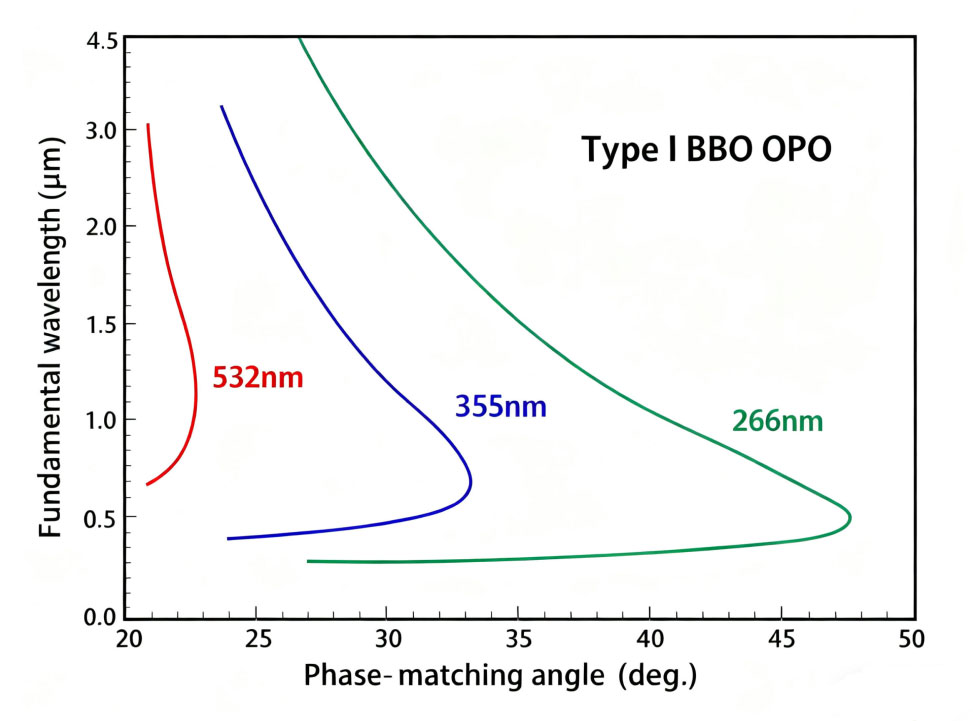
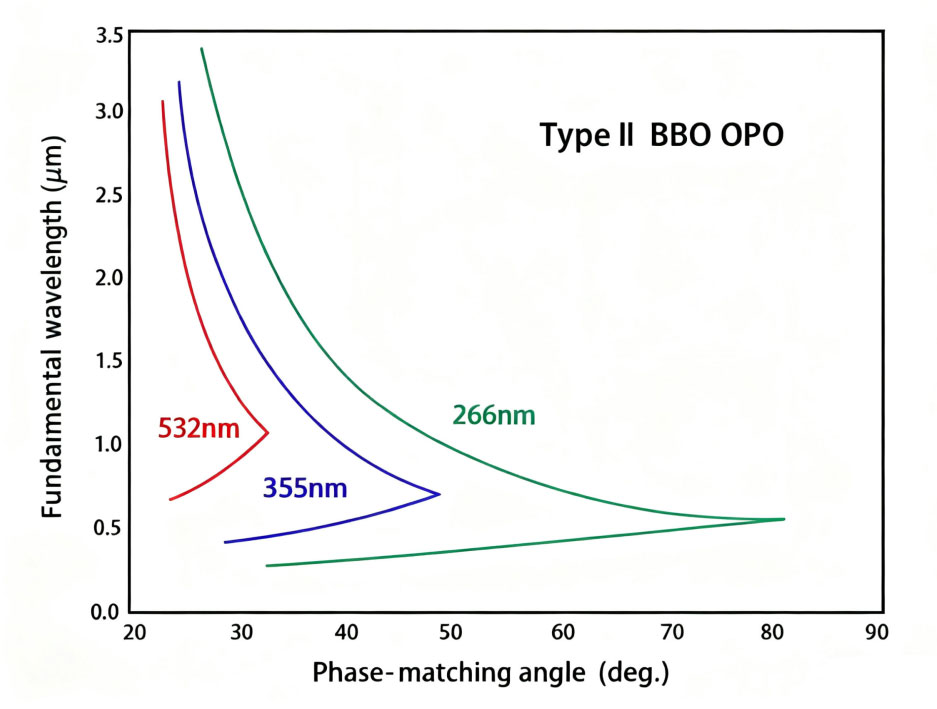
Type I BBO OPO tuning curve (@532/355/266 nm) Type II BBO OPO tuning curve (@532/355/266 nm)
 

 Application Fields

Semiconductor and Microelectronics Manufacturing

1.Semiconductor Lithography and Inspection
In advanced process nodes of 7 nm and below, BBO crystals serve as a core component in deep‑ultraviolet (DUV) laser inspection equipment. By means of frequency doubling, the fundamental laser is converted to 266 nm DUV light, enabling high‑precision identification of random defects on wafer surfaces smaller than 5 nm — such as copper wiring shorts and micro‑bridges. This helps increase defect capture rates at the 3 nm node by 40 % and reduce false‑positive rates by 35 %, directly improving wafer fab yield. Additionally, BBO crystals can be integrated into the optical alignment modules of lithography systems; their low absorption ensures stability of the lithography beam path, breaking foreign monopolies on high‑end lithography‑grade BBO crystals.
2 Precision Micromachining for Microelectronics
Suited for high‑density interconnect PCBs, Mini/Micro LED chips, and other semiconductor‑related manufacturing scenarios: as the key UV laser frequency‑doubling element, BBO efficiently converts laser light to 266 nm DUV, achieving micrometer‑ or even nanometer‑scale etching, drilling, and cutting. For example, in PCB trace processing, line‑width accuracy can be controlled within ±2 μm, with processing efficiency improved by 50 % compared with conventional methods. Large‑size BBO crystals (e.g., 20 × 20 × 20 mm) further support integration into multi‑channel micromachining systems, meeting mass‑production needs such as UV cutting of new‑energy battery electrodes and repair of flexible OLED display circuits.

Laser and Optoelectronic Equipment

2.1 High‑Power Laser Manufacturing
In all‑solid‑state lasers, BBO crystals perform critical functions including frequency doubling, sum‑frequency generation, and optical parametric oscillation (OPO): they can double 1064 nm infrared laser light to 532 nm green light, and further double it to 266 nm DUV, making them suitable for industrial‑grade high‑power laser marking and welding equipment. In ultrafast laser systems, BBO’s excellent laser‑induced damage threshold (≥ 5 GW/cm² @ 1064 nm, 10 ns pulse width) supports stable output of femtosecond and picosecond pulses for precision medical and scientific research applications.
2.2 Optical Detection and Sensing
Integrated into high‑end optical instruments such as DUV spectrophotometers and Raman spectrometers: leveraging BBO’s high transmittance and low absorption in the DUV range enhances detection sensitivity for molecular structure analysis and trace elemental identification. Applications include environmental pollutant monitoring (VOCs, heavy metals), harmful substance screening in food and pharmaceuticals, and industrial product composition analysis, with detection precision improved by 1–2 orders of magnitude over traditional instruments.

Scientific Research and Medical Fields

3.1 Frontier Scientific Research
Provides essential support for fundamental studies in quantum optics, coldatom physics, astrophysics, etc.: as a frequency‑doubling crystal for DUV laser sources, it generates 266 nm and shorter wavelength lasers used in laser cooling of atoms, quantum state control, and planetary atmospheric composition detection. For instance, in quantum computing research, BBO crystals enable photon entanglement preparation, improving qubit manipulation accuracy.
3.2 Medical Devices and Biosafety
In healthcare, BBO is compatible with DUV laser therapy and disinfection equipment. On one hand, integrated into minimally invasive dental treatment and skin lesion repair devices, the precise bactericidal and tissue ablation properties of 266 nm DUV light improve treatment accuracy and safety while reducing postoperative infection risk. On the other hand, used in high‑level biosafety disinfection systems, large‑size BBO crystals expand the disinfection beam path to meet requirements such as inactivation of biological samples in laboratories, rapid sterilization of medical waste, and environmental disinfection in intensive care units.

 Communications and Defense

4.1 Optical and Quantum Communication
In high‑speed optical communication systems, BBO crystals act as core components in optical switches and modulators; utilizing their electro‑optic effect enables fast control of optical signals, meeting high bandwidth and low latency demands of 5G/6G networks. In quantum communication, entangled photon pairs generated via BBO are used to construct quantum key distribution (QKD) systems, ensuring absolutely secure information transmission for confidential communications in finance, government, and other sectors.
4.2 Defense and Aerospace
Applied in defense equipment such as LIDAR, electro‑optical countermeasures, and space exploration: as a frequency‑doubling crystal for LIDAR, BBO produces high‑power DUV lasers that enhance detection accuracy for low‑altitude and stealth targets. In electro‑optical countermeasure systems, it can rapidly generate intense UV laser pulses to jam enemy optical detection devices. Furthermore, it is suitable for spacecraft‑borne UV spectrometers used in analyzing space atmospheric constituents and planetary surface materials.
I am interested in BBO
Submit