


产品目录
客服热线(售前售后)
13805064553

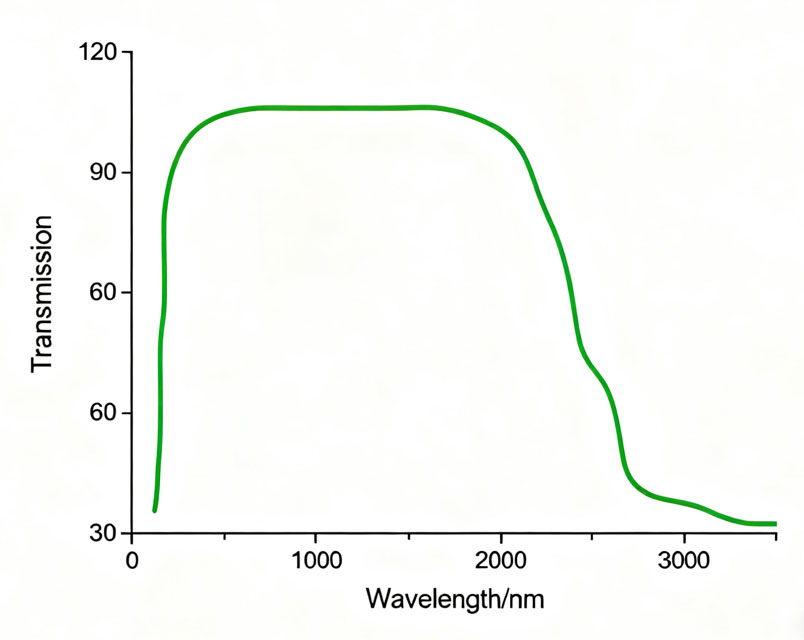
LBO, namely Lithium Triborate Crystal (LiB₃O₅), is an excellent nonlinear optical crystal. It features a wide transmission range, high damage threshold, moderate nonlinear coefficient, and excellent optical uniformity, and is widely used in various laser frequency conversion applications.
|
Physical Quantity
|
Value
|
Remarks
|
|
Crystal Structure
|
Orthorhombic
|
/
|
|
Lattice Parameters
|
a=8.4473 Å, b=7.3788 Å, c=5.139 Å, Z=2, Room temperature
|
Room temperature
|
|
Melting Point
|
834 °C
|
/
|
|
Mohs Hardness
|
6
|
/
|
|
Density
|
2.47 g/cm³
|
/
|
|
Thermal Conductivity
|
3.5 W/m·K
|
Room temperature
|
|
Thermal Expansion Coefficients
|
αₓ=10.8×10⁻⁶/K, αᵧ=−8.8×10⁻⁶/K, α_z=3.4×10⁻⁶/K, 25–200 °C
|
25–200 °C range
|
|
Transparency Range
|
160–2600 nm
|
/
|
|
SHG Phase Matching Range
|
Type I: 551–2600 nm; Type II: 790–2150 nm
|
Room temperature
|
|
Thermo‑optic Coefficients
|
dnₓ/dT=−9.3×10⁻⁶/°C, dnᵧ/dT=−13.6×10⁻⁶/°C, dnz/dT=(−6.3−2.1λ)×10⁻⁶/°C
|
Room temperature
|
|
Absorption Coefficient
|
<0.1%/cm @1064 nm; <0.3%/cm @532 nm
|
/
|
|
Beam Divergence (Angular Acceptance)
|
6.54 mrad·cm (Φ, Type I, 1064 nm SHG); 15.27 mrad·cm (θ, Type II, 1064 nm SHG)
|
/
|
|
Temperature Bandwidth
|
4.7 °C·cm (Type I, 1064 nm SHG); 7.5 °C·cm (Type II, 1064 nm SHG)
|
/
|
|
Angular Acceptance
|
6.54 mrad·cm (Φ, Type I, 1064 nm SHG); 15.27 mrad·cm (θ, Type II, 1064 nm SHG)
|
/
|
|
Nonlinear Optical Coefficients
|
d₃₁=1.05±0.09 pm/V; d₃₂=−0.98±0.09 pm/V; d₃₃=0.05±0.006 pm/V
|
/
|
|
Sellmeier Equations (λ in μm)
|
nx²=2.454140+0.011249/(λ²−0.011350)−0.014591λ²−6.60×10⁻⁵λ⁴; ny²=2.539070+0.012711/(λ²−0.012523)−0.018540λ²+2.00×10⁻⁴λ⁴; nz²=2.586179+0.013099/(λ²−0.011893)−0.017968λ²−2.26×10⁻⁴λ⁴
|
/
|
|
Item
|
Specific Parameter
|
|
Dimensional Tolerance
|
(W±0.1mm)×(H±0.1mm)×(L+0.5/-0.1mm), custom sizes accepted
|
|
Clear Aperture
|
95% of central region diameter
|
|
Flatness
|
λ/8 @ 633 nm
|
|
Transmitted Wavefront Distortion
|
λ/8 @ 633 nm
|
|
Surface Finish
|
10/5 per MIL-PRF-13830B standard
|
|
Parallelism
|
20 arcsec
|
|
Perpendicularity
|
15 arcmin
|
|
Angular Deviation
|
Δθ ≤ 0.1°, Δφ ≤ 0.1°
|
|
Chamfer
|
≤ 0.2 mm × 45°
|
|
Edge Chipping
|
≤ 0.1 mm
|
|
Damage Threshold
|
>10 GW/cm² @ 1064 nm, 10 ns, 10 Hz (polished wafer); >0.5 GW/cm² @ 532 nm, 10 ns, 10 Hz (AR-coated)
|
|
Quality Guarantee Period
|
1 year under normal use
|
 |
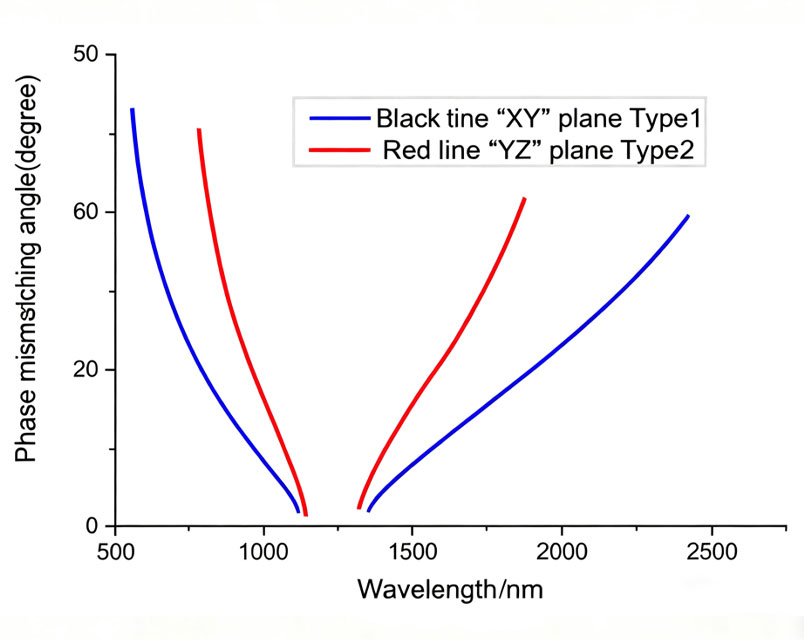 |
| LBO Crystal Transmittance Curve | LBO Nonlinear Crystal SHG |
 |
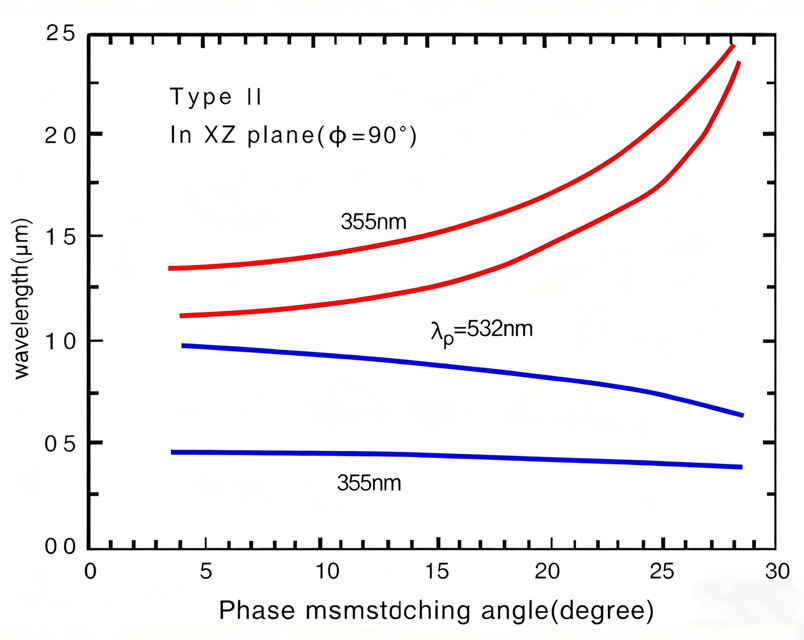 |
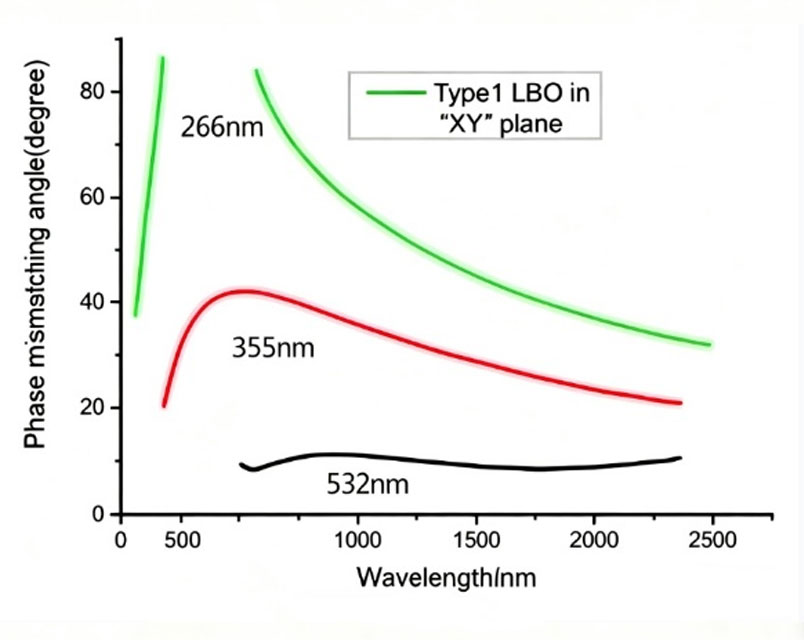
| Type I LBO OPO Tuning Curve | Type II LBO OPO Tuning Curve |