产品目录
客服热线(售前售后)
13805064553

CLBO, namely Cesium Lithium Borate Crystal (CsLiB₆O₁₀), is a new type of nonlinear optical crystal with excellent properties. It features a wide transmission range, high nonlinear coefficient, large spectral and temperature bandwidths, and no second harmonic absorption. It performs outstandingly in the fields of high-power laser frequency conversion and deep ultraviolet laser generation.
|
Physical Quantity
|
Value
|
Remarks
|
|
Crystal Structure
|
Tetragonal system
|
/
|
|
Lattice Parameters
|
a=b=10.494 Å, c=8.939 Å (1 Å=10⁻¹⁰ m), Room temperature
|
Room temperature
|
|
Symmetry
|
Z=4
|
—
|
|
Melting Point
|
Approx. 844.5 °C
|
/
|
|
Mohs Hardness
|
5.5
|
/
|
|
Density
|
2.461 g/cm³
|
Room temperature
|
|
Thermal Conductivity
|
1.25 W/m·K
|
Room temperature
|
|
Transmission Range
|
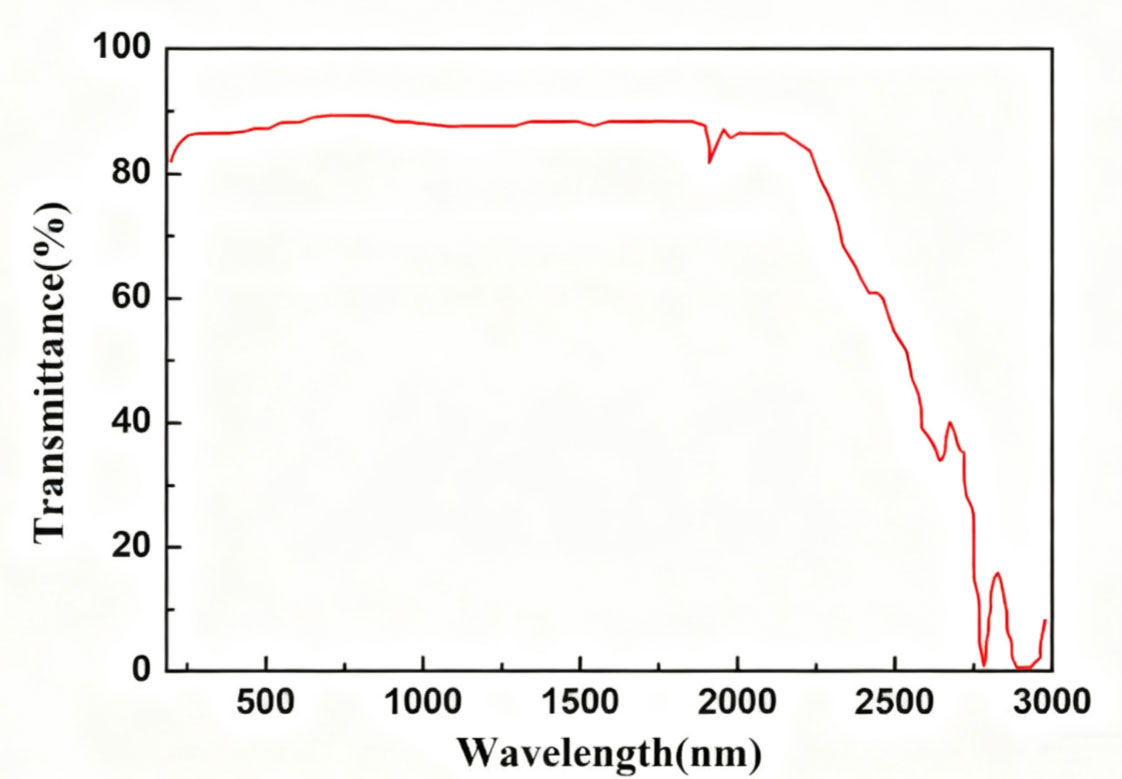
175 nm–2750 nm
|
/
|
|
Damage Threshold
|
26 GW/cm²
|
—
|
|
Thermo-optic Coefficients
|
dno/dT=-1.9×10⁻⁶/°C, dne/dT=-0.5×10⁻⁶/°C, Room temperature
|
Room temperature
|
|
Absorption Coefficient
|
266 nm UV:<0.05 cm⁻¹; 532–1064 nm Visible-NIR:<0.01 cm⁻¹
|
/
|
|
Refractive Index
|
1064nm: ne=1.4340, no=1.4838; 532nm: ne=1.4445, no=1.4971
|
—
|
|
Walk-off Angle
|
1.78°@1064nm, 1.83°@532nm, 0.98°@488nm
|
/
|
|
Angular Acceptance
|
0.5–1 mrad·cm (e.g. 266nm 4th harmonic)
|
/
|
|
Nonlinear Optical Coefficient
|
deff(I)=d₃₆ sinθₘ sin(2φ); deff(II)=d₃₆ sin(2θₘ) sin(2φ)
|
—
|
|
Sellmeier Equations
|
nₒ²=2.2104+0.01018/(λ²–0.01424)–0.01258λ²; nₑ²=2.0588+0.00838/(λ²–0.01363)–0.00607λ², 25°C
|
25°C
|
|
Item
|
Specific Parameter
|
|
Dimensional Tolerance
|
(W±0.1mm)×(H±0.1mm)×(L+0.5/-0.1mm), custom sizes accepted
|
|
Clear Aperture
|
95% of central region diameter
|
|
Flatness
|
λ/6 @ 633 nm
|
|
Transmitted Wavefront Distortion
|
λ/8 @ 633 nm
|
|
Surface Finish
|
10/5 per MIL-PRF-13830B standard
|
|
Parallelism
|
20 arcsec
|
|
Perpendicularity
|
15 arcmin
|
|
Angular Deviation
|
Δθ ≤ 0.1°, Δφ ≤ 0.1°
|
|
Chamfer
|
≤ 0.2 mm × 45°
|
|
Edge Chipping
|
≤ 0.1 mm
|
|
Quality Guarantee Period
|
1 year under normal use
|
|
CLBO Transmittance Spectrum |
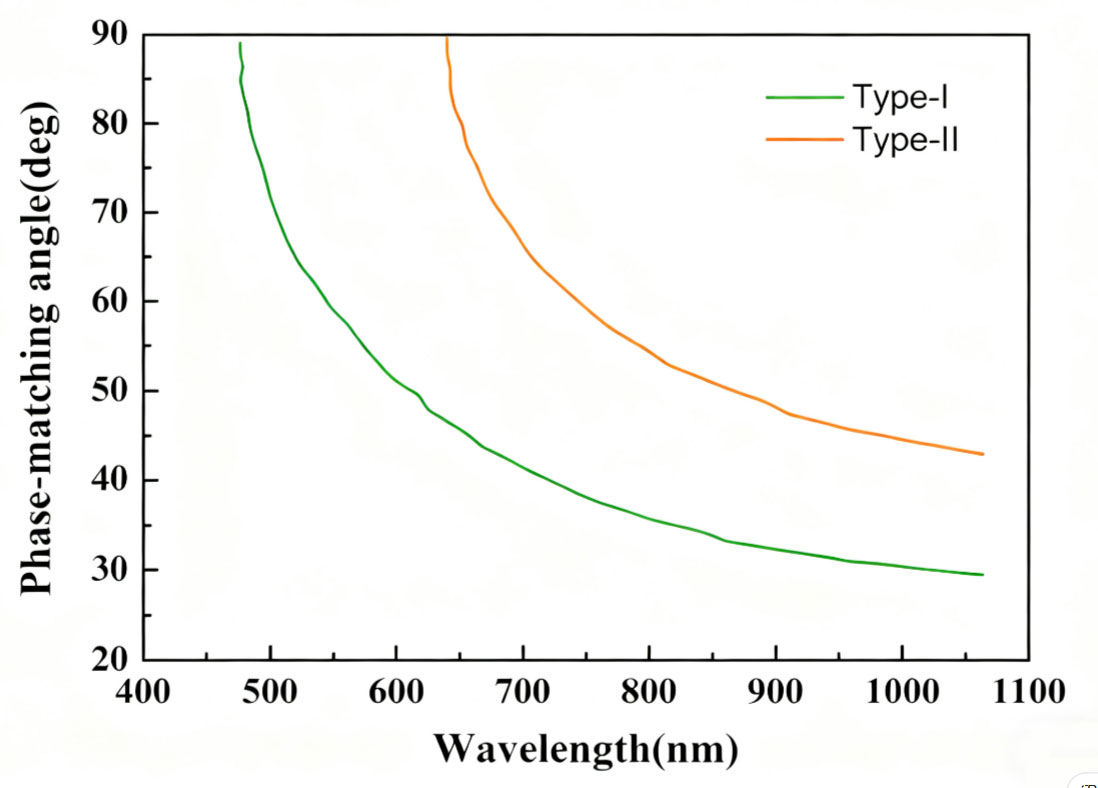
Phase-Matching Angles of Type I and Type II vs. Fundamental Wavelength |
1. Semiconductor Industry.
CLBO crystals can achieve harmonic outputs at 193 nm and 266 nm, with a cutoff wavelength as low as 180 nm, making them ideal for semiconductor lithography and semiconductor inspection. In semiconductor lithography, the UV laser generated by CLBO enables fine patterning of chips, improving integration density and performance.
2. Materials Processing.
With high damage threshold and low absorption, and no two‑photon absorption, CLBO crystals are suitable for high‑power laser systems. Lasers derived from CLBO allow precise cutting, etching, or modification without damaging surrounding material—essential precision for industries such as electronics, e.g., processing tiny electronic components.
3. Bomedical Field.
The excellent efficiency of CLBO‑generated UV lasers makes them valuable in medical diagnostics. UV light penetrates tissue more deeply and provides higher clarity, delivering clearer and more detailed images for more accurate and timely diagnosis, such as detecting small tumors or vascular abnormalities.
4. UV Lidar Applications.
Thanks to its properties, CLBO is suitable for UV lidar systems used in target detection and environmental monitoring. The UV laser produced by CLBO enables more precise detection and identification.